WEEK 1
Göbekli Tepe
Göbekli Tepe
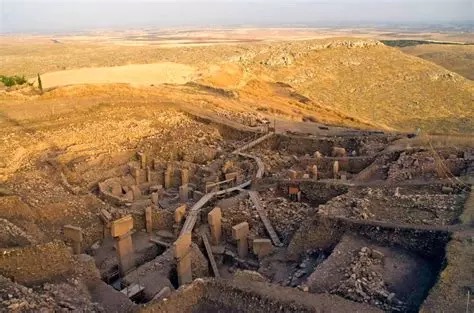
At the south of modern day Turkey, near the border with Syria, lies the archaeological site of Göbekli Tepe. This site contains finds that show that at the time homo sapiens started a new relation with their environment...
Introduction
At the south of modern day Turkey, near the border with Syria, lies the archaeological site of Göbekli Tepe. This artificial mound (a so-called tell) of about 15 meters height and 300 meters circumference, contains more than 200 T-shaped stone pillars organized in about twenty circles. The dating of this site shows that is was eracted about twelve to ten thousand years ago. To put things in a chronological perspective: the time between Göbekli Tepe and the oldest known Egyptian pyramids is about three times the time between those pyramids and our present day.
The site is discovered in 1963 and excavated by the Deutsches Archäologisches Institut – but large parts still remain unexcavated. Even though the exact meaning and purpose of this site remain a mystery, it has been suggested that this structure could be seen as one of the oldest known temples in the world. And when we compare the findings here with the cave paintings we find at Lascaux, interesting differences start to become apparent.
This week's activities
3 items practical
Signposting the future
A small exercise to let you think about your own artistic practice.
 reading
From Horizontal to Vertical
Below, you will find a small documentary on how technological innovations at the end of the Paleolithic led to a change in metaphysical thought, which in turn induced the shift to farming.
practical
Exercise 3: loaded locations
In this exercise, you are invited to look at places and the way story-telling can change the meaning of a place.
practical
Teamwork
When you do things together, sometimes a kind of 'energy' starts to emerge: a feeling of you being part of something bigger than yourself.
reading
Göbekli Tepe: Reading exercise
Cave paintings like we find at Lascaux cannot be seen as 'art works' in the modern sense of the word. They are more comparable to media: utensils to come into contact with the spiritual world that lies behind the everyday physical one.
practical
Exercise 1: the meaning of artefacts
Everything we do has a relation to artefacts: the things we encounter in our daily life. In this exercise, we are going to investigate this relation.
practical
Exercise 2: observed communities
In this exercise, we are going to investigate ad hoc communities: a group of people that do not know each other, but together form a sort of community.